
The 5 most common mistakes when arranging a flower bouquet - and how to avoid them
- January 9, 2026
Arranging a bouquet is one of those activities that looks easy until... you try to do it yourself.
And suddenly it appears that the flowers are living their lives - some disappear under others, others stubbornly stand off to the side, and the whole composition, instead of stunning, looks like a 'temporary something' that was meant to be something beautiful.
And yet every bouquet has the potential to become a small work of art.
All it takes is a little bit of knowledge, a few good habits and a moment of mindfulness for the flowers to start arranging the way you want them to - softly, naturally, with character.
Most importantly: errors are absolutely normal.
They are committed by everyone - beginners, enthusiasts, sometimes even experienced florists when they are pressed for time. This is a good sign.
Because every mistake tells you what you can still learn and how you are building your floral style step by step.
In this article, I will talk about the five most common stumbling blocks that occur when creating bouquets.
Not to discourage you - on the contrary.
To show how easy it is to turn chaos into harmony and how a few simple rules can make your compositions start to feel light and confident.
1. choosing too many types of flowers at once
This is one of the most common mistakes that gets all floristry enthusiasts - especially at the beginning.
You walk into a flower shop, see all these colours, shapes, scents... and it's hard to resist.
You want to take home 'a little bit of each' and then combine it all into one bouquet.
And this is where the chaos begins.
Too much variety means that the flowers, instead of working together, start to compete.
Everyone wants to attract attention, everyone 'plays first fiddle', making the composition lose its coherence.
The result is a bouquet that is full of good intentions - but difficult to find harmony in.
🌸 How to avoid this?
🔹 Rule of 2-3 species
Choose a maximum of two or three types of flowers as a base.
This gives order, rhythm and balance.
The rest can be an accessory - a delicate background that only emphasises the character of the bouquet.
🔹 One dominant
Let there be a 'main character' in the bouquet: garden rose, ranunculus, peony, hydrangea.
Let the other flowers build space and lightness around it.
🔹 Working with seasonality
Flowers that naturally bloom at the same time of year often look best together.
Coincidence? Not necessarily.
Nature is well versed in composition.
🔹 Principle of repetition
Instead of multiple species - use a few flowers repeated more times.
This is the easiest way to make a bouquet look 'cohesive but not boring'.
🌿 Remember:
Less really is more.
When you give flowers space, they can each tell their story - subtly, without fighting for attention.
2. lack of proper flower condition
You can have a great idea for a bouquet, beautiful colours and the perfect vase, but if the flowers are not in good condition - the whole composition will simply fail.
It's a bit like cooking: even the best recipe won't help if the ingredients are tired or have lost their freshness.
In floristry freshness is not a luxury - it's essential.
Sometimes we choose flowers that are a little shriveled, with leaves that have flapped, a stem that is too short or buds that no longer have the strength to open.
Sometimes we don't even notice these little details - especially when we are excited about the idea of a bouquet.
And then, after the composition has been arranged, something 'goes wrong'.
The flowers drop quickly, lose their colour and the bouquet lives shorter than we would like.
🌿 How to avoid this mistake?
🔹 Conditioning is a ritual to start with
Gently pruning the stems at an angle, clean water, florist conditioner (even homemade) - a few simple steps and the flowers will repay you with a longer life.
🔹 Remove leaves below the waterline
Leaves submerged in water rot and make the water spoil faster.
Removing the lower leaves not only prolongs the life of the bouquet, but also adds lightness.
🔹 Take care of the temperature
Flowers do not like heat or cold.
Transporting them in a hot car or leaving them next to a radiator can ruin the whole effect.
🔹 Choose buds that still have potential
The most beautiful bouquets are often made from flowers that are just starting to open - they are full of energy and promise.
🌸 Remember:
The beautiful bouquet begins long before the first flower was laid.
Good plant health is fundamental - without it, even the best composition will not flourish as it should.
3. wrong proportion of the bouquet - too flat or too wide
This is one of those mistakes that have nothing to do with the colour or choice of flowers, yet can completely take away from the charm of the bouquet.
A composition can be beautiful in its details, but if the proportions are disturbed, something in it just 'doesn't sound'.
As a result, instead of being eye-catching, the bouquet looks as if... it's a bit lost.
There are bouquets flatas if someone had pressed down on them with their hand from above.
They lack height, space, soft movement.
There are also those that are spreading from side to side, resembling a fan or a bifurcated bunch of greens.
It is then difficult to be elegant - instead of harmony, it is a mess.
This is most often the case when flowers are arranged 'as they fall', with no stem direction, no point of attachment, no structure.
🌿 How to avoid this?
🔹 Learn to work spirally
This is the most important technique in bouquet arranging.
The stems should lay in one direction, cross in the same place and create a fine, natural structure.
This gives the bouquet a height, lightness and stability.
🔹 Start from the middle
Some bouquets are created 'from the outside in' and this immediately makes the cake.
When you start with one main flower, it is easier to control the proportions and movement of the whole composition.
🔹 Imagine the shape before you start
Circle, triangle, teardrop, hemisphere...
Florists like geometry - not to rigidly adhere to it, but to know what you are aiming for.
🔹 Leave the air between the flowers
The most beautiful bouquets have space.
Not all flowers need to stand 'shoulder to shoulder'.
Sometimes one loose bell or twig adds more charm than five more roses.
🌸 Remember:
Good proportions are not perfection - they are balance.
A bouquet should have rhythm, direction and space, just as music has silence between notes.
It is these spaces that make the composition 'come to life'.
4. overgreening or a complete lack thereof
The greenery in the bouquet acts like a breath - it makes the composition alive, gaining depth and naturalness.
But that is precisely why it is so easy to exaggerate here.
When the green is too much, the bouquet loses its lightness.
The flowers get lost somewhere between the leaves, the whole thing gets heavy, dense, overwhelming.
Instead of a subtle background, the result is a thicket that engulfs even the most beautiful roses or buttercups.
When green there is no, a second problem arises - the bouquet looks like a tight bunch of flowers with no structure or direction.
It lacks breath, softness and that 'something' that makes a composition stop being a collection of flowers and start being a bouquet.
✨ How to avoid this mistake?
🔹 Treat greenery as a backdrop, not the main feature
It is meant to accentuate the flowers, not overwhelm them.
🔹 Combine different textures, but with sensitivity
2-3 types of greens are completely sufficient - ruscus + herbs + ornamental grass can work wonders.
🔹 Leave some "air"
Don't try to fill every gap.
The visible space between the flowers is one of the secrets of beautiful, natural bouquets.
🔹 One dominant green + delicate accessories
This is the simplest way to maintain harmony.
🌸 Remember:
The ideal amount of greenery is one that gives the composition frame and breath, but does not take away from the scene of the flowers.
Green is a whisper, not a shout - it is meant to support, not dominate.
5. inadequate tying of the bouquet
This is one of those small steps that is easy to forget - and which can decide everything.
You can create a beautiful composition, choose the perfect colours, take care of the proportions....
But if the bouquet is badly tied, the whole intricately built structure starts to fall apart.
The flowers spread out to the sides.
The bouquet loses its shape.
And it doesn't stand in the vase, it just tilts as if looking for support.
Tying it too loosely makes the whole thing look like a haphazardly gathered bunch.
Too strong - crushes the stems, deprives them of water and makes the bouquet quickly lose its freshness.
This is one of those moments where technique meets delicacy - you have to do 'just right'.
🌿 How to avoid this mistake?
🔹 Tie the bouquet exactly where the stems cross
This is the natural 'centre of gravity' of the composition.
If you catch the bouquet higher or lower, it loses its form.
🔹 Use a material that will not injure the stems
The best performers are:
- cotton cord
- raffia
- thin florist's elastic band
They are strong but delicate - they will hold the bouquet without crushing it.
🔹 Tighten but do not squeeze
This is important.
The bouquet should be stable but still 'breathable'.
Flowers do not like ties that are too strong or too weak.
🔹 Trim the stems evenly and at the right angle
This ensures that the bouquet stands straight, has visual harmony and stays fresh for longer.
✨ Remember:
A well-tied bouquet is one that can be picked up with one hand, turned over, rotated slightly - and it still holds its shape.
This is a sign that the composition has balance, rhythm and calm.
Summary
Arranging bouquets is an art that grows with you.
Every mistake teaches you something, every brush of green and every imperfect arc of the stem brings you closer to your own style.
Over time, you start to see more and more: the rhythm of the composition, the natural movement of the flowers, their need for space.
The bouquet doesn't have to be perfect - it has to be yours.
Create, try, improve.
And if you want to learn more, discover techniques in practice and feel floristry "in the palms of your hands", take a look at our Floristry Workshops tab.
At florist workshop in Katowice we teach exactly these techniques - in practice, without stress and with attention to detail

W Korcu Maku
Recommended entries
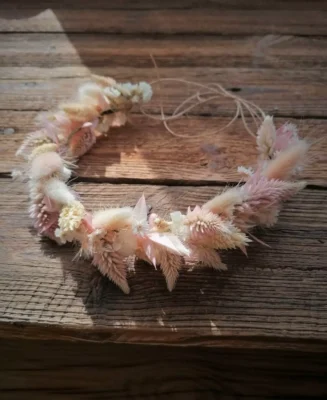
My path to becoming a florist - a story of passion and craftsmanship
The path to floristry is not always obvious. In this post, I talk about my first inspirations, artistic training and discovering a passion for working with flowers. This is the story of how art, craft and floristry came together in a profession that gives me joy and fulfilment.
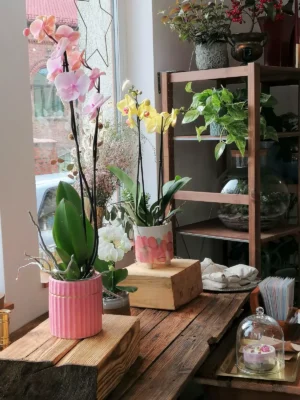
Plants for interiors - florist advice Katowice
Potted plants not only decorate interiors, but also improve air quality and mood. See which species will work best in different rooms of the house - from the kitchen to the bedroom.
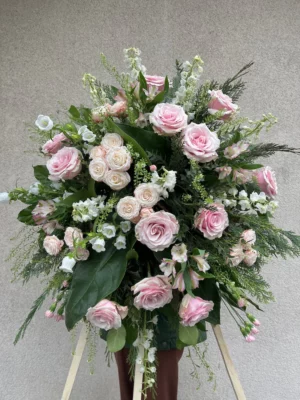
Funeral floristry Katowice - a guide to compositions
Funeral floristry is a unique area of flower arranging art in which aesthetics are combined with symbolism and respect. Choosing the right composition - from a bouquet to a wreath or urn decoration - depends on many factors. In this article, we outline the most common forms of funeral floristry and their significance.
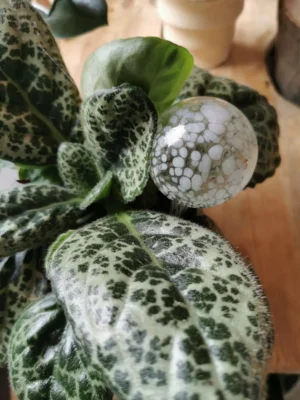
Irrigation balls for plants - a convenient solution.
Have you heard of them yet? If not, I'm already explaining. They are brilliant! I have several species of plants in my flower shop that love them!